 Austria
  Belgium
  Canada
  Denmark
  Finland
  France
  Germany
  Italy
Italy  Mexico
  Netherlands
  Norway
  Poland
  Spain
Spain  Sweden
  United Kingdom
  USA
USA 
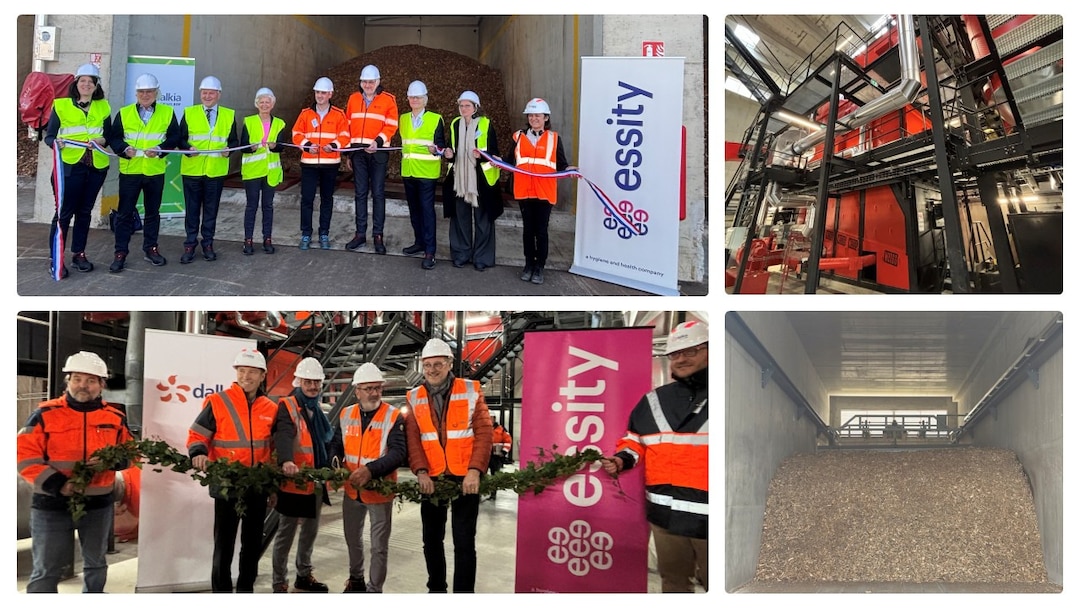
The newly inaugurated biomass installations at Essity’s Kunheim (Alsace) and Le Theil-sur-Huisne sites (Normandy) enable a significant share of the energy required for paper hygiene production to be generated from renewable, locally sourced biomass. Together, these projects illustrate Essity’s strategy to progressively replace fossil fuels with sustainable energy solutions across its industrial footprint.
At Essity’s sites in Kunheim and Le Theil-sur-Huisne, newly commissioned biomass installations with capacities of 7 and 5.8 megawatts, respectively, now cover between 70% and 75% of each site’s steam requirements.
These projects are expected to reduce the sites’ natural gas consumption by up to 53% and cut the carbon footprint of paper machines by up to 42%. The renewable energy generated supports the manufacturing of private-label paper hygiene products, including toilet paper, paper towels and tissues, primarily for the French and European markets.
“Decarbonizing our operations is a key pillar of Essity’s sustainability strategy and a core part of delivering on our science-based climate targets,” said Sahil Tesfu, Chief Strategy and Sustainability Officer at Essity. “By scaling up renewable and locally sourced energy across our production sites, we are driving measurable emissions reductions today while strengthening the resilience and competitiveness of our industrial operations.”
Beyond reducing Essity’s own operational emissions, these investments lower the carbon footprint of the manufacturing stage of private-label hygiene products. This helps retail customers reduce the overall footprint of their product ranges and offer consumers paper hygiene products with a continuously lower CO2 impact.
The biomass projects are part of long-term energy partnerships and have received public support under national and European programs1 aimed at accelerating the industrial energy transition. They also contribute to strengthening local wood value chains and enhancing the energy sovereignty of the regions where Essity operates.
With a strong industrial presence in France for more than 60 years, Essity continues to invest in modernizing its sites and reducing environmental impact, with a clear focus on cutting operational emissions. The Kunheim and Le Theil-sur-Huisne projects demonstrate how local initiatives form an integral part of Essity’s global sustainability strategy.
1 These projects have financially been supported by the European Union and the French Government as part of the Recovery Plan operated by ADEME (French Agency for Ecological Transition).