 Austria
  Belgium
  Canada
  Denmark
  Finland
  France
  Germany
  Italy
Italy  Mexico
  Netherlands
  Norway
  Poland
  Spain
Spain  Sweden
  United Kingdom
  USA
USA 
Antimicrobial resistance (AMR) occurs when bacteria adapt and no longer respond to treatments and medicines that are meant to kill them, such as antibiotics or antiseptics, making infections harder, and sometimes impossible, to treat.2 While AMR is often associated with hospitals or severe illness, experts warn that routine wound care is one of the most common situations in which antimicrobials are used, and often overused.1
“Antimicrobial resistance is not an abstract or future threat. It is already affecting patients today,” says Anand Chandarana, President Health & Medical at Essity. “Everyday decisions in wound care are important. Using active antimicrobials when they are not specifically needed increases resistance and puts patients at greater risk.”
Wounds and resistant infections, an underestimated risk - International experts report increasing antimicrobial resistance in common wound types, including surgical wounds, diabetic foot ulcers, pressure injuries and venous leg ulcers.1 When resistant bacteria are involved, wounds tend to heal more slowly, infections are harder to control and patients are more likely to need stronger antibiotics, longer hospital stays or surgery.3
Research also shows that many wounds are colonised by bacteria without being infected. Despite this, active antimicrobial treatments are frequently used “just in case” rather than based on clear signs of infection, a practice widely recognised as a major driver of antimicrobial resistance.1,4 A global survey among health care practitioners reports that 42% of clinicians use antimicrobials as a preventive measure, even when infection is not confirmed.4
“Too often, antibiotics are used as a precaution rather than a necessity,” says Anand Chandarana, President Health & Medical at Essity. “Focusing on prevention and smarter first-line wound care helps protect patients today by using antibiotics when it's really needed and preserves the effectiveness of antibiotics for the future, in case of spreading or systemic infection for instance”.
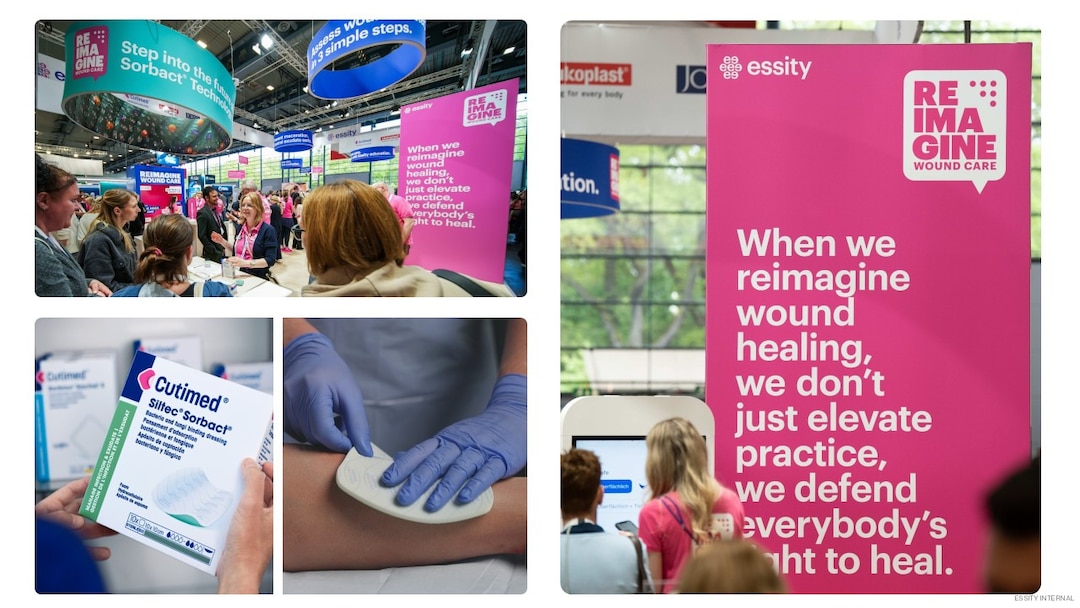
New international guideline1 published in the Journal of Wound Care - At EWMA 2026, Essity highlighted a new International Guideline on Antimicrobial Stewardship in Wound Care,1 developed by 12 independent wound care experts from around the world and published in the peer-reviewed Journal of Wound Care.
This guideline on antimicrobial stewardship1 positions wound care as a core element of antimicrobial resistance prevention, providing clear, practical pathways to support better infection prevention, early intervention and responsible use of antimicrobials. Importantly, it recognises both the use of active antimicrobials and the role of microbial-binding dressings in wound care. For example, Essity’s Sorbact Technology dressings bind microbes and physically remove them from the wound without releasing active antimicrobial agents.5 By avoiding antimicrobial agents, these solutions support infection prevention while helping reduce unnecessary antibiotic use.
Essity supported the development of this guideline on antimicrobial stewardship1 as a sponsor, with no influence over its content or guidance, as the work was reviewed and published independently through the Journal of Wound Care. This guideline1 reflects a growing scientific consensus on the importance of alternatives to antimicrobials such as antibiotics in routine wound care and a shift towards infection prevention and control.
“Having internationally recognised experts publish this guidance in a respected scientific journal is a strong signal to healthcare professionals,” says Anand Chandarana. “It shows that evidence-based wound care solutions can support antimicrobial stewardship while improving patient outcomes.”
From reaction to prevention - Rather than relying on antibiotics or active antimicrobial dressings as a default, this guideline on antimicrobial stewardship1 encourages healthcare professionals to adopt early intervention and step-by-step decision pathways tailored to different wound types. By starting with treatments that physically remove bacteria instead of killing them, infection risk can be minimised to help prevent the progression of infection and limit the use of antimicrobials such as antibiotics.1
As a global hygiene and health company, Essity works closely with healthcare professionals to support safer, more sustainable care practices. At EWMA 2026, Essity engaged with clinicians, researchers and partners to share insights from this international guideline on antimicrobial stewardship1 and discussed how improved wound care can contribute to the global fight against antimicrobial resistance.
“Protecting the effectiveness of antibiotics is a shared responsibility,” concludes Anand Chandarana. “By rethinking how wounds are managed every day, we can help reduce unnecessary antibiotic use and make a real difference for patients and healthcare systems alike.”
1 Idensohn P et al. International guideline on antimicrobial stewardship and the role of microbial-binding dressings in wound care 2026: infection prevention, control, early intervention and treatment. J Wound Care. 2026;35(5A):S1–S40.
2 World Health Organization. Global action plan on antimicrobial resistance. 2015. https://www.who.int/publications/i/item/9789241509763 (accessed 24 February 2026).
3 Cristea A-G, Lisă E-L, et al. Antimicrobial Smart Dressings for Combating Antibiotic Resistance in Wound Care. Pharmaceuticals. 2025; 18(6):825.
4 Probst A et al. Healthcare practitioners' perspectives on infection management, antimicrobial resistance and stewardship in wound care practice. J Wound Care. 2025;34(11):910-920.
5 Husmark J et al. Antimicrobial effects of bacterial binding to a dialkylcarbamoyl chloride-coated wound dressing: an in vitro study. J Wound Care. 2022;31:560-570.